


The Challenge
The Lake Sal watershed encompasses approximately 600 acres of diverse land use, including residential neighborhoods, commercial developments, and vital transportation corridors. For years, this basin struggled with several critical drainage deficiencies; during large storm events, water frequently topped Zetterower Road and Northlake Drive, creating hazardous driving conditions and cutting off neighborhood access. Residents near the Lake Sal spillway and downstream along Northlake Drive and Needle Lane reported regular flooding of yards and, in some cases, homes. Poor drainage and undersized stormwater infrastructure also contributed to the problem. Initial assessments found that a purely structural solution, such as building regional upstream detention, was not cost-effective for the City.
The Solution
The City of Statesboro chose to pursue a more efficient, technology-driven solution. At the core of the project is Opti’s Continuous Monitoring & Adaptive Control (CMAC) technology. Rather than relying on a static pond, Lake Sal now uses a cloud-based platform that monitors NOAA weather forecasts and actively manages water levels. When a significant storm is predicted, the system automatically opens a valve at the lake’s outlet structure to lower the water level in advance. This pre-storm drawdown - typically around two feet - creates approximately 19.5 acre-feet of additional storage within the existing lake footprint. During the storm, CMAC continues to adjust releases in real time, maximizing available storage while reducing downstream impacts.
It Takes Teamwork
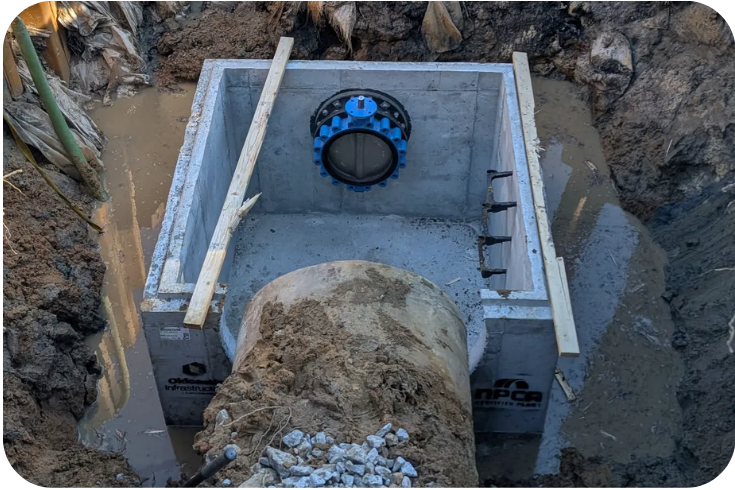
During construction, the project required replacement of the outlet control structure and close coordination across multiple teams. GMC, the design engineer for the City of Statesboro, developed the specifications while Opti and Oldcastle Infrastructure partnered to provide the first smart-enabled outlet control structure. The design ensured the actuated valve assembly was seamlessly integrated before arriving on-site. EnviroTrac completed field installation using the purpose-built design. This coordinated approach enabled efficient implementation and resulted in a fully integrated, high-performing system aligned with the project’s goals.
The Results
- Cost Efficiency. The CMAC system cost approximately 60% less than a regional pond, but provided over 10 times the storage capacity (19.5 ac-ft vs. 1.5 ac-ft).
- Minimum Footprint. The project required no land acquisition and had zero wetland impacts, as the only construction involved modifying the existing outlet structure.
- Community Balance. Because the drawdown only happens when a storm is imminent, the lake remains at its normal level for recreation and wildlife habitat most of the year.


.png)